FSSAI · Food Safety & Hygiene
FSSAI Cold Chain Advisory: Transport and Storage Rules for Paneer, Meat, Fish and Khoa
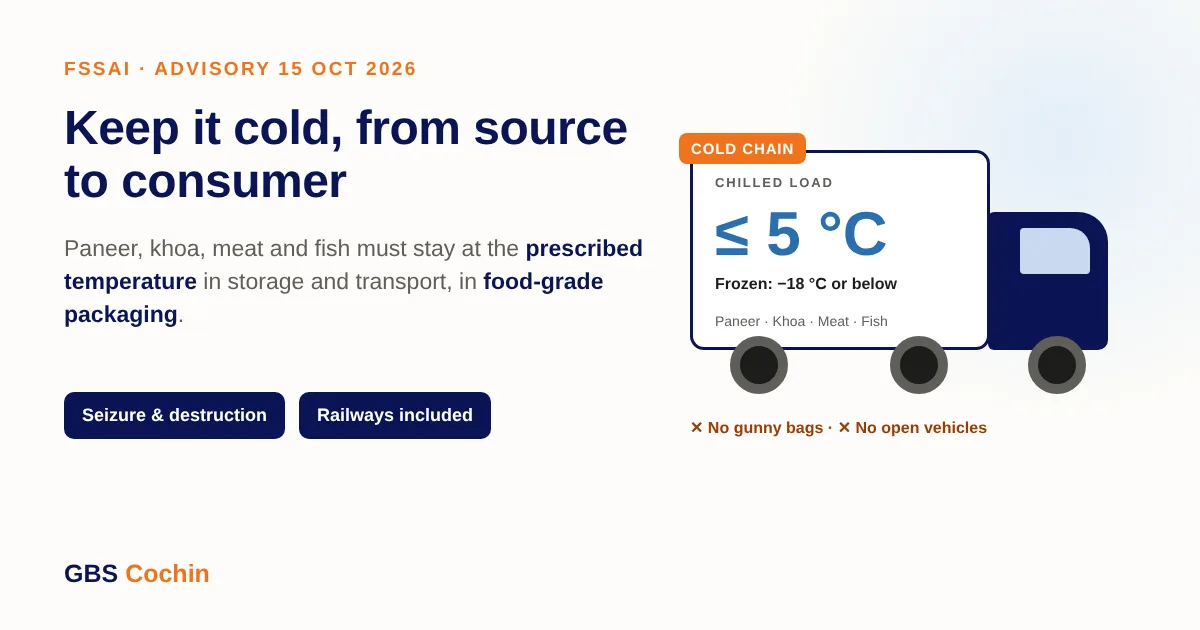
On 15 October 2026, FSSAI's cold chain advisory directed every food business that makes, packs, stores, transports, distributes or sells perishable foods such as khoa, paneer, meat and fish to keep them at the prescribed temperature from sourcing until they reach the consumer. Transport must use clean, covered vehicles, and packaging must be food-grade, so gunny bags are out. Officers can seize and destroy food that doesn't comply.
FSSAI cold chain advisory: key facts
- What: "Advisory on Handling, Storage and Transportation of Perishable Food Commodities under Controlled Temperature Conditions".
- Reference: F. No. RCD-15001/11/2021-Regulatory-FSSAI, dated 15 October 2026, issued by FSSAI's Regulatory Compliance Division.
- Products named: khoa, paneer, meat and fish "etc.". It covers perishable foods generally, not only these four.
- Who it covers: every food business involved in manufacture, packing, storage, transport, distribution or sale of these foods.
- Legal basis: the hygiene requirements and conditions of licence in Schedule 4 of the FSS (Licensing and Registration of Food Businesses) Regulations, 2011.
- Enforcement: State Food Safety Commissioners, Indian Railways and FSSAI Regional Directors have been told to keep "strict vigilance during inspections and transportation checks". Non-compliant food can be seized and destroyed.
- Deadline: none. The advisory reinforces existing rules, so they apply now.
Why did FSSAI issue this advisory?
FSSAI says it has been "brought to the notice of FSSAI" that perishable foods such as khoa, paneer, meat and fish "are at times not handled, stored or transported under appropriate temperature conditions". These foods are highly susceptible to microbial growth and spoilage when they get warm. FSSAI calls exposing them to the wrong temperature "temperature abuse": it endangers public health, and it already breaches the hygiene and sanitary requirements of Schedule 4.
The rule isn't new. Schedule 4's conditions of licence already require businesses to maintain the prescribed temperature throughout the supply chain, "from procurement/sourcing to delivery to the end consumer including during chilling, transportation, storage and distribution", and to handle and transport these products under controlled temperature. What's new is the order to enforce it, including at transport checks.
The five things every food business must now do
Paragraph 4 of the advisory directs food businesses to ensure strict compliance with the following:
- Clean, covered, hygienic vehicles. Transport only in vehicles or conveyances suitable for carrying food. Open pickups and shared, uncleaned vehicles are the obvious risk.
- The prescribed temperature, all the way through. Keep the required temperature during both storage and transport, not just in the cold room.
- Food-grade packaging only. Use food-grade primary packaging and suitable secondary packaging. FSSAI says packing or transporting in gunny bags or other non-food-grade coverings "shall be avoided".
- Protection from contamination. Protect products from dust, moisture, pests, physical damage and cross-contamination during storage, loading, unloading and transport.
- Records and traceability. Keep records of each consignment, and produce invoices or other documents whenever the authority asks for them.
What temperature counts as "prescribed"?
The advisory doesn't print temperatures. It points to existing requirements. Schedule 4's hygiene requirements for licensed food businesses use these commonly cited reference points:
| Food condition | Reference point under Schedule 4 |
|---|---|
| Chilled, potentially high-risk food (such as fresh paneer, khoa, meat, fish) | Received at or below 5 °C |
| Frozen food | Received at −18 °C or below |
| Raw meat, poultry and seafood in storage | Cold stored separately from processed, cooked and packaged products |
| Thawed food | Not to be refrozen once thawed |
Product standards, your licence conditions and the manufacturer's label can set specific storage temperatures for a product. Where they do, follow the stricter requirement. A dairy, meat or seafood unit's food safety plan should state its own critical limits.
Who has to comply?
The advisory is addressed to "all Food Business Operators" across the chain:
- Manufacturers and processors: dairy units making paneer and khoa, sweet shops, meat processors, seafood processing plants
- Packers and repackers
- Cold storages and warehouses
- Transporters, including fish and meat trucks, delivery fleets and rail consignments
- Distributors and wholesalers
- Retailers: meat and fish stalls, supermarkets, dairy outlets, and the dark stores behind quick-commerce apps
Food transporters are food businesses in their own right and need their own FSSAI registration or licence. Many small transport operators don't have one, and roadside checks will expose that first.
What's different about railways?
The advisory goes beyond state food safety officials. It's also addressed to the Railway Board and Indian Railways, asking them to direct the officers concerned to keep up vigilance. Perishables moving by rail, including parcel consignments and refrigerated wagons, can therefore expect checks too.
Why this matters in Kerala
Kerala eats more fish and meat than most of India, and much of it travels long distances by road before it reaches the market, especially during the monsoon trawling ban. That is when temperature abuse, and the chemicals used to hide it, become most tempting. In June 2026, Kerala Kaumudi reported that hundreds of people in Thiruvananthapuram district were hospitalised after eating stale fish treated with chemicals during the trawling ban. Kerala's Food Safety Department has run repeated inspection drives on fish and meat, including Operation Matsya, which seized and destroyed thousands of kilograms of stale and chemically treated fish.
With this advisory, officers checking fish trucks, meat shops and dairy outlets in Kerala now have a clear national instruction behind them. They will be looking at how perishables are carried and stored, not just whether they've gone bad.
What happens if you don't comply?
FSSAI says "appropriate action including seizure and destruction may be initiated in cases of non-compliance" under the FSS Act, 2006, and its regulations. In practice:
- Seizure and destruction of the consignment or stock
- Improvement notices, and suspension or cancellation of your licence if they aren't complied with
- Penalties under the FSS Act, depending on the facts. Section 56 provides a penalty of up to ₹1 lakh for food prepared or processed in unhygienic or unsanitary conditions. Food that turns out sub-standard or unsafe brings heavier penalties.
- Operating without a licence, which is common among small transporters and cold stores, is a separate offence under Section 63.
Cold chain compliance checklist
- Make sure every business in your chain, including your transporter and cold store, holds a valid FSSAI registration or licence for its activity.
- Use insulated or refrigerated vehicles suitable for food, clean them between loads, and never carry non-food goods in them.
- Replace gunny bags and reused sacks with food-grade crates, liners and packaging.
- Keep temperature records for cold rooms and vehicles, including loading and arrival readings.
- Keep invoices and dispatch documents with every consignment, so you can trace it from source to delivery.
- Train staff on loading, unloading and the time product may spend outside cold storage.
- Review your Schedule 4 compliance and food safety plan, especially if you hold a State or Central License with an inspection due.
Frequently asked questions
What is FSSAI's cold chain advisory of October 2026?
It's an FSSAI advisory dated 15 October 2026 (F. No. RCD-15001/11/2021-Regulatory-FSSAI). It directs all food businesses dealing in perishable foods such as khoa, paneer, meat and fish to keep them at the prescribed temperature throughout storage and transport, use clean and covered vehicles and food-grade packaging, protect them from contamination, and keep consignment records.
Can perishable food be transported in gunny bags?
No. The advisory says packing or transporting perishable food in gunny bags or other non-food-grade coverings that may compromise product safety should be avoided. Only food-grade packaging and suitable secondary packaging should be used.
What temperature should paneer, meat and fish be kept at?
The advisory requires the prescribed temperature without stating figures. Schedule 4's hygiene requirements commonly cite receiving potentially high-risk chilled food at or below 5 °C and frozen food at −18 °C or below. Product standards and licence conditions can set specific limits for individual products.
Does the advisory apply to transporters and retailers?
Yes. It applies to every food business involved in manufacture, packing, storage, transportation, distribution and sale of perishable foods, so it covers transporters, cold stores, wholesalers and retail outlets as well as manufacturers.
What is the penalty for not maintaining the cold chain?
Officers can seize and destroy non-compliant food. Depending on the facts, the business can also face improvement notices, licence suspension or cancellation, and penalties under the FSS Act, 2006, such as up to ₹1 lakh under Section 56 for unhygienic or unsanitary processing.
Is there a deadline to comply?
No. The advisory enforces conditions that already exist in Schedule 4 of the 2011 Licensing and Registration Regulations, so they apply immediately.
Dairy, meat, fish or cold storage business?
GBS Cochin makes sure your business, and your transporter and cold store, hold the right FSSAI licence for each activity, so a roadside check doesn't stop your stock. Your first consultation is free.
Book Free Consultation WhatsApp 80756 60788- FSSAI Advisory F. No. RCD-15001/11/2021-Regulatory-FSSAI, dated 15 October 2026. See FSSAI advisories.
- Business Today: FSSAI tightens checks on how paneer, meat, fish and khoa reach consumers
- The South First: FSSAI warns of seizure over temperature violations
- Maritime Gateway: Railways brought into enforcement
- Schedule 4, Part II: food operations and controls (summary)
- TaxGuru: offences and penalties under the FSS Act, 2006
- Kerala Kaumudi: chemically treated fish hospitalises hundreds in Thiruvananthapuram (June 2026)
This article is general information based on FSSAI's published advisory and regulations, and is not legal advice. Temperature requirements can vary by product and licence conditions. For your specific business, speak to a qualified professional.